
Combat Hapkido
A modern Hapkido system focused on practical self-defense.
Combat Hapkido (Chon-Tu Kwan Hapkido) is an eclectic modern Hapkido system founded by John Pellegrini in 1990. It is a self-defense system that reinterprets and applies a selected body of traditional Hapkido techniques, emphasizing practical, modern self-defense over traditional forms. The International Combat Hapkido Federation (ICHF), formed in 1992, serves as its governing body and was recognized in 1999 by the Korea Kido Association and the World Kido Federation as the Hapkido style Chon Tu Kwan Hapkido.
- field
- Martial Arts / Self-Defense
- founder
- John Pellegrini
- founded
- 1990
- governing_body
- International Combat Hapkido Federation (ICHF)
- headquarters
- Fernandina Beach, Florida
- also_known_as
- Science of Self-Defense
Lore & Background
Combat Hapkido was created by John Pellegrini in 1990 as a structured self-defense system based on scientific principles and modern concepts, not as a new martial art. In 1992, Pellegrini formed the International Combat Hapkido Federation (ICHF) to govern the system. The ICHF was recognized in 1999 by the Korea Kido Association and the World Kido Federation (collectively the Kido Hae) as the Hapkido style Chon Tu Kwan Hapkido. The system omits traditional techniques deemed impractical for modern self-defense, such as acrobatic break falls, jump/spinning kicks, forms, meditation, and weapons like swords. Instead, it incorporates features from Sambo, Judo, Jujutsu, Vale Tudo, Western Boxing, and Daitō-ryū Aiki-jūjutsu to enhance its core curriculum.
Reader's Guide
Combat Hapkido's significance lies in its systematic adaptation of traditional Hapkido for contemporary self-defense, addressing criticisms that traditional styles lack ground defense and practical weapon training. Its core curriculum is organized into ten belt ranks, with all certifications handled by the ICHF Headquarters in Florida. The system includes optional modules such as 'Ground Survival,' 'Anatomical Target Striking/Pressure Points,' and 'Cane' techniques, supported by DVDs and seminars. The ICHF also offers a 'Tactical Pressure Points' program and an 'Anatomical Compliance Tactics' course for law enforcement. By focusing on joint locks, pressure points, grappling, and low kicks, and by integrating techniques from other martial arts, Combat Hapkido provides a modern, adaptable self-defense framework that has gained international recognition through the Kido Hae.
Did You Know?
- Combat Hapkido is also referred to as the 'Science of Self-Defense'.
- The ICHF was recognized by the Korea Kido Association and the World Kido Federation in 1999.
- Combat Hapkido omits acrobatic break falls, jump/spinning kicks, forms, and meditation.
- The system's 'Ground Survival' program was developed with assistance from Brazilian Jiu-Jitsu expert Carlson Gracie Jr.
Origins & Institutional Recognition
John Pellegrini established Combat Hapkido in 1990, creating what he described not as a new martial art but as a structured self-defense system grounded in scientific principles and modern thinking. Two years later, in 1992, he formalized the International Combat Hapkido Federation as the official governing body overseeing the style. The system's legitimacy received a significant boost in 1999 when the Korea Kido Association and the World Kido Federation—collectively known as the Kido Hae—officially recognized it under the Korean name Chon Tu Kwan Hapkido. This recognition carries particular weight because the World Kido Federation is acknowledged by the South Korean government as the bridge connecting Korea's official martial arts authority to the global martial arts community. Pellegrini himself emphasized that his contribution was one of curation and application rather than invention, selecting a focused body of Hapkido techniques and reorganizing them around the practical goal of modern self-defense. The ICHF is headquartered in Fernandina Beach, Florida, where all rank certifications are processed and filed.
Eclectic Methodology & Tactical Focus
Combat Hapkido deliberately sets itself apart from traditional Hapkido styles by adding the word "Combat" to its name, signaling a singular focus on self-defense rather than broad martial arts practice. The system draws techniques from a wide array of disciplines, including Sambo, Judo, Jujutsu, Vale Tudo, Western Boxing, and Daito-ryu Aiki-jutsu, weaving these into a cohesive curriculum. Where traditional Hapkido has been criticized for lacking substantial ground-fighting content, Combat Hapkido actively addresses this gap by researching and integrating grappling methods from multiple sources. It also incorporates derived versions of Jeet Kune Do trapping and entering techniques to smooth transitions into its core joint-locking and throwing work. At the same time, the style consciously omits elements deemed impractical for contemporary self-defense: acrobatic break falls, jumping and spinning kicks, formal forms, meditation, and weapons such as swords. The remaining core techniques center on joint locks, pressure points, grappling holds, throws, hand strikes, and low kicks, all trained with an emphasis on small circular motion, force redirection, footwork, and body positioning to gain leverage over an opponent.
Rank Structure & Modular Training
Combat Hapkido organizes its curriculum into ten belt ranks, with the number and difficulty of required techniques increasing progressively at each level. While individual schools may vary in how they present specific rank content, the core curriculum must be taught before any promotion is submitted to ICHF Headquarters in Florida for certification, ensuring consistent time-in-grade standards are met. For higher Dan-grade black belt examinations, candidates must appear personally before Grandmaster John Pellegrini, either at the headquarters or at one of the numerous seminars held across the United States and internationally. Beyond the mandatory core, the ICHF develops optional modules that complement the base curriculum, including programs such as Stick and Knife Combatives, Ground Survival, Combat Throws, Anatomical Target Striking, Trapping, Cane, Dan Bong, and Weapons Disarming. Each module is supported by DVDs, dedicated seminars, and instruction from certified instructors. Students are required to master the core curriculum for promotion but are encouraged to explore these additional modules, and instructors may require certain modules for advancement. Extensive video reference libraries are provided to schools and individual students through the ICHF.
Ground Survival & Tactical Pressure Points
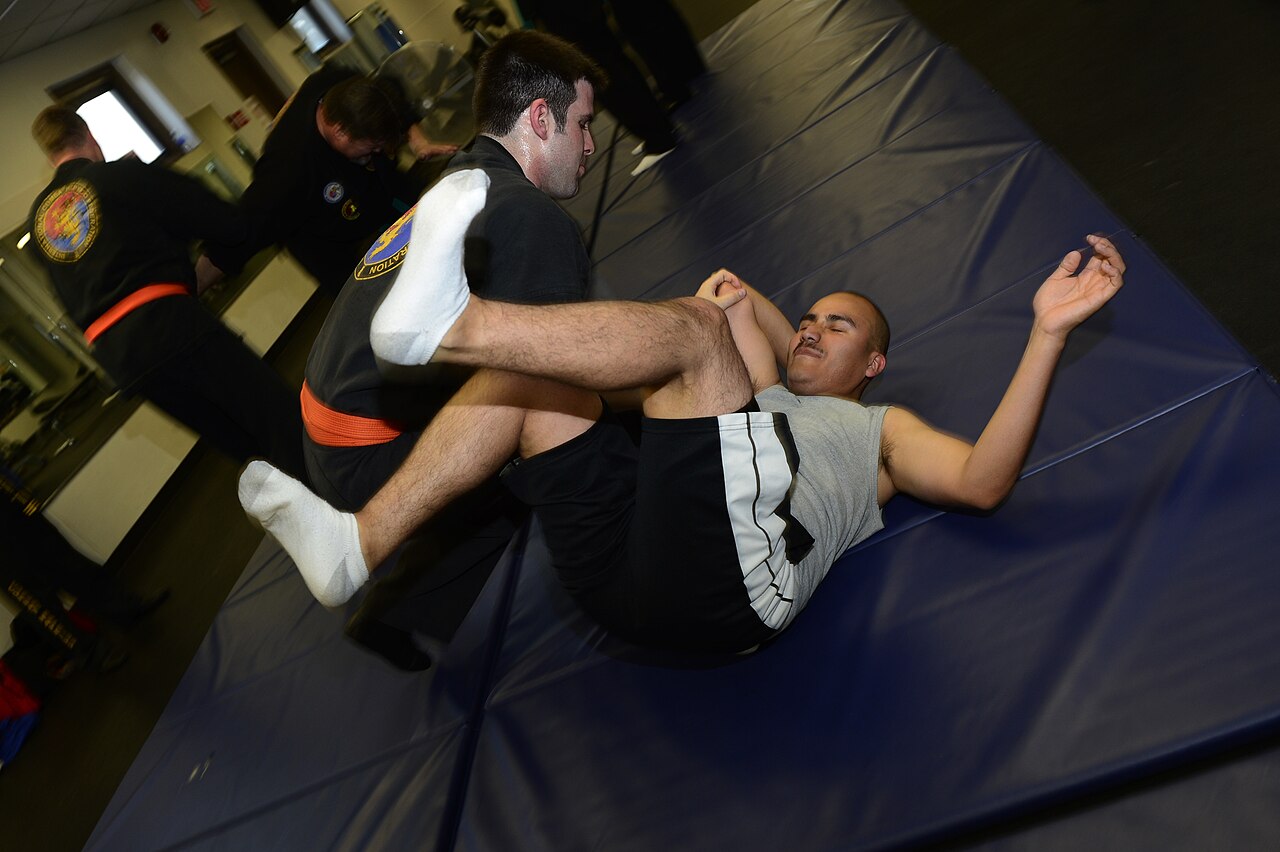
Two specialized programs illustrate Combat Hapkido's commitment to practical, scenario-based self-defense. The Ground Survival program—formerly called Ground Grappling—was designed not to encourage prolonged ground engagements but to equip practitioners with the ability to escape, evade, and prevent takedowns, prioritizing quick transitions back to a standing position. To build this curriculum, Combat Hapkido Master Instructors with grappling backgrounds researched Brazilian Jiu-Jitsu, Vale Tudo, and Combat Sambo, receiving additional technical guidance from Brazilian Jiu-Jitsu expert Carlson Gracie Jr. The program integrates small and large joint locks alongside pressure point techniques drawn from the style's Anatomical Targeting Strategies. The second program, known as Tactical Pressure Points, was developed to sharpen the effectiveness of the core curriculum by teaching practitioners to target vulnerable areas and weak points on an attacker's body, enhancing the manipulations and control techniques already central to Combat Hapkido's joint-locking and throwing work.
Gallery


Frequently Asked Questions
What is Combat Hapkido?
Combat Hapkido, also called Chon-Tu Kwan Hapkido, is a modern self-defense system that takes selected techniques from traditional Hapkido and reworks them for real-world practicality. It was established in 1990 by John Pellegrini and is sometimes referred to as the "Science of Self-Defense."
Who created Combat Hapkido and when?
John Pellegrini founded the system in 1990, designing it as an eclectic approach that prioritizes applicable self-defense over rigid traditional forms. He based the curriculum on a curated selection of Hapkido techniques rather than a full traditional syllabus.
How does Combat Hapkido differ from traditional Hapkido?
Rather than following a set of prescribed forms, Combat Hapkido strips down traditional Hapkido to a focused toolkit of techniques meant for modern self-defense scenarios. The emphasis is on practical application and adaptability instead of preserving a fixed traditional curriculum.
What is the International Combat Hapkido Federation (ICHF)?
The ICHF is the governing body for Combat Hapkido, established in 1992 with its headquarters in Fernandina Beach, Florida. It oversees the system's standards, ranking, and global instruction.
Has Combat Hapkido received any official recognition?
In 1999, both the Korea Kido Association and the World Kido Federation formally recognized the style under the name Chon Tu Kwan Hapkido. This gave the system an internationally acknowledged identity within the broader Kido martial arts family.
More in Martial arts in the United States 1-24
Spotted an error? Know more?
This is a living reference — every entry is fact-audited, and reader corrections feed straight into our audit queue. Suggest an edit · See this site's audit record