
American Kenpo Karate
A hybrid martial art emphasizing rapid strikes and self-defense.

Wikipedia / Wikimedia Commons
American Kenpo Karate—also called American Kenpo or Ed Parker’s Kenpo Karate—is a hybrid martial art that Ed Parker developed and systematized in the United States in the mid-1900s. The style focuses on fast striking combinations, self-defense moves, and a teaching framework that kept changing over time. Parker created a structured program of strikes, forms, and defensive techniques, and this curriculum spread through schools across the U.S. and around the world.
The term *kenpō* (sometimes spelled *kempō*) comes from the Japanese reading of Chinese characters meaning “fist method” or “boxing method.” In Cantonese, the same characters are read *kuen fat*; in Mandarin, *quánfǎ*. In modern Chinese, the term generally refers to any striking or boxing techniques rather than a single style. In Japanese, *kenpō* originally described Chinese-derived boxing systems, but today it can also mean striking-based martial arts in general. Several modern systems use the name, including American Kenpo and Shorinji Kempo.
American Kenpo does not have a single, standardized curriculum across all schools. This is because Parker’s art evolved throughout his life, so students learned different material depending on when they trained with him. Many instructors left before Parker made his later updates. After Parker’s death in December 1990, various teachers modified how the art was taught. Parker did not appoint a successor as Senior Grandmaster of the International Kenpo Karate Association (IKKA); instead, he trusted his senior students to continue his teachings in their own ways, which led to several distinct derivative styles.
Despite these differences, many American Kenpo schools share common principles and theories. One is the “Marriage of Gravity,” where students learn to settle their body weight to generate more force in strikes. Another is the idea that every block can be a strike and every strike a block—blocks should be forceful enough to injure an opponent, and strikes can disrupt an opponent’s movement. The “Point of Origin” principle means moving a natural weapon directly from where it starts, without cocking, to avoid telegraphing moves. “Economy of Motion” teaches practitioners to choose the best target, weapon, and angle in the least time. “Personalization” encourages students, after learning the “ideal phase” of a technique, to adapt it to their own needs and s
- field
- Hybrid martial art system
- known_for
- Rapid striking combinations, self-defense techniques, evolving instructional framework
- founder
- Ed Parker
- origin
- United States
- era
- Mid-20th century
Lore & Background
American Kenpo today lacks a standardized curricula across schools, due to various reasons: Parker's art evolved over time, so his students learned a different curriculum depending on when they studied with him; many instructors left Parker before his later updates to the system; after Parker's death, various instructors changed the way the art was taught. Parker did not name a successor as Senior Grandmaster of the IKKA, instead entrusting his senior students to continue his teachings in their own ways, leading to the creation of several distinct derivative styles.
Common elements across schools include the 'Marriage of Gravity'—settling body weight to increase striking force; the principle that every block is a strike and every strike is a block; 'Point of origin'—moving any natural weapon directly from where it originates; 'Economy of motion'—choosing the best target, weapon, and angle in the least time; and 'Personalization'—students tailoring techniques to their needs after learning the ideal phase. Parker created eleven forms, three short and eight long, and 154 named ideal phase technique sequences with 96 extensions, taught in three stages: Ideal Phase, What-if Phase, and Formulation Phase.
Reader's Guide
American Kenpo Karate's significance lies in its systematic approach to self-defense and striking, developed by Ed Parker as a hybrid art blending influences from Chinese and Japanese martial arts. Its legacy is marked by a lack of centralized authority after Parker's death, leading to diverse interpretations and derivative styles. The art's principles—such as economy of motion and the marriage of gravity—have influenced modern self-defense training. The IKKA logo, designed by Dave Parker in 1958, symbolically represents the art's modernized form while acknowledging its Eastern roots, featuring a tiger (early training), dragon (later spiritual strength), circle (continuity), and Chinese characters for 'Law of the Fist' and 'Spirit of the Dragon and the Tiger.' The belt ranking system includes white through 10th-degree black, with specific markings for higher ranks. Parker's curriculum emphasized not only techniques but also character and contributions to the art for higher promotions.
Did You Know?
- The term Kenpo is an English romanization of the Japanese reading of the Chinese characters meaning 'fist method' or 'boxing method.'
- Parker created 154 named ideal phase technique sequences with 96 extensions, taught in three stages: Ideal Phase, What-if Phase, and Formulation Phase.
- The IKKA logo was designed by Dave Parker, Ed Parker's brother, in 1958.
- Promotion after third-degree black belt has more to do with contributions made back to the art, such as teaching and exploration.
Origins and the Making of a Hybrid Art
American Kenpo Karate emerged in the United States during the mid-twentieth century as a deliberately constructed hybrid martial art, shaped by Ed Parker's vision to codify striking, forms, and self-defense into a unified instructional system. Unlike a single traditional lineage, Parker drew upon multiple Eastern sources to build a curriculum that emphasized rapid combinations of strikes, practical self-defense applications, and an ever-evolving framework for teaching. The name itself carries a layered etymology: the Japanese reading "kenpō" of the Chinese characters 拳法 translates simply as "fist method" or "boxing method." In contemporary Chinese usage, those same characters denote a broad category of striking arts rather than one specific style, and in Japanese they historically encompassed any Chinese-derived boxing system. Parker's creation thus sits at a crossroads of linguistic and cultural tradition, yet it was forged in an American context and spread through schools across the United States and eventually worldwide. The result is a system that is neither purely Chinese nor purely Japanese but a distinctly American synthesis of Eastern striking principles.
Philosophy of Striking and Self-Defense
Parker's system is built on a set of interlocking principles that treat every movement as both offensive and defensive. The "Marriage of Gravity" instructs students to sink their body weight into a strike to multiply its force. Equally central is the doctrine that every block functions as a strike and every strike functions as a block: a well-executed parry is meant to injure the opponent and disrupt their ability to continue attacking, while a strike is timed to counter the opponent's motion and neutralize their next move. The "point of origin" principle demands that a limb travel directly from its resting position to the target without first being drawn back, eliminating the telltale telegraphing that warns an opponent of an incoming blow. "Economy of motion" pushes the practitioner to select the optimal target, the optimal weapon, and the most open angle in the shortest possible time. Finally, "personalization" encourages students, once they have mastered the ideal phase of a technique, to adapt it to their own body, strengths, and needs rather than performing a rigid, one-size-fits-all pattern.
Forms, Phases, and the Belt Ladder
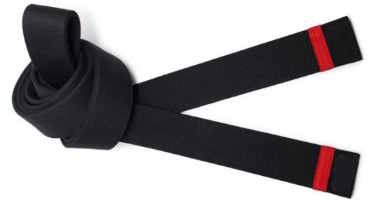
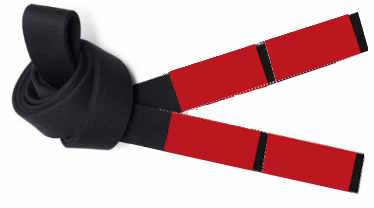
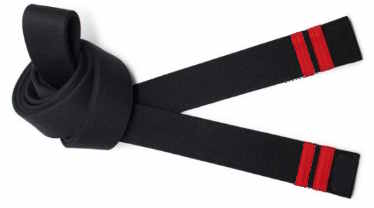
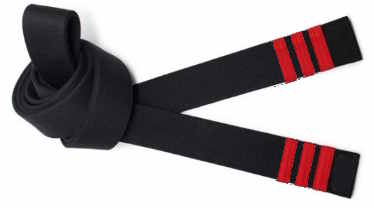
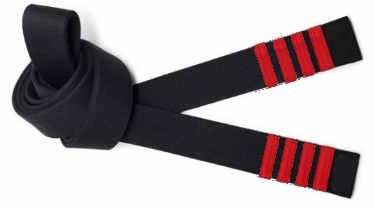
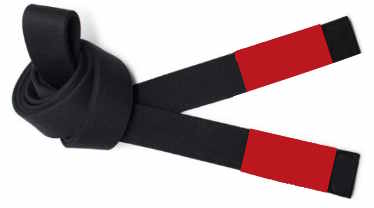
By the time of his death in December 1990, Parker had composed eleven distinct forms—three short and eight long—alongside 154 named ideal-phase technique sequences accompanied by 96 extensions. These sequences were organized into a three-stage teaching progression: the Ideal Phase, the What-if Phase, and the Formulation Phase, allowing students to move from a canonical demonstration through hypothetical variations to personal application. The belt structure of American Kenpo runs from white through yellow, orange, purple, blue, green, three brown degrees, and ten black-belt degrees. Black-belt rank is visually marked by half-inch red tips up to the fourth degree, a five-inch block at the fifth, and additional half-inch stripes through the ninth; the tenth degree is distinguished by two five-inch blocks separated by a half-inch gap. In Parker's IKKA schools, each belt required mastery of twenty-four techniques, though some modern schools have regrouped the same material into a sixteen-twenty-four syllabus that front-loads fewer techniques at lower ranks.
Fragmentation, Legacy, and the IKKA Emblem
Parker never designated a single successor as Senior Grandmaster of the IKKA. Instead, he entrusted his senior students to carry forward his teachings in their own manner, a decision that, combined with the fact that his art continued to evolve and that many instructors departed before his later revisions, produced a proliferation of distinct derivative styles. Today no single standardized curriculum unites all American Kenpo schools. The IKKA logo, designed in 1958 by Ed's brother Dave, encapsulates the art's identity: a tiger beneath a dragon symbolizes the progression from physical strength and basic stances to fluidity, agility, and spiritual discipline, with the dragon placed above to affirm that mental and moral strength must govern the martial artist. A surrounding circle denotes continuity, internal dividing lines echo the original attack methods of ancient Chinese practitioners, and colored bands mirror the belt ranking from white through black to red. The overall shape resembles a house with curved walls to ward off evil, while an axe at the base serves as a stark warning that any member who tarnishes the organization's reputation will be severed entirely.
Gallery
Frequently Asked Questions
What is American Kenpo Karate?
American Kenpo Karate is a hybrid martial art system developed in the United States during the mid-20th century that blends rapid striking sequences with practical self-defense applications. It is not a single fixed style but an evolving instructional framework that has been refined and expanded over several decades.
Who founded American Kenpo Karate?
Ed Parker is credited with creating and systematizing the art in the United States. He assembled a structured curriculum of strikes, forms, and defensive techniques that became the backbone of what is now taught in Kenpo schools worldwide.
What does the name 'Kenpo' actually mean?
The word kenpō (sometimes rendered as kempō) is the Japanese reading of Chinese characters that translate to 'fist method' or 'boxing.' It reflects the art's emphasis on hand-based striking rather than a single national tradition.
How is American Kenpo different from traditional Japanese or Okinawan karate?
Rather than following a fixed lineage, American Kenpo is a hybrid system that prioritizes fast combination strikes and real-world self-defense over rigid kata repetition. Its teaching framework is designed to keep adapting, so instructors can update techniques as new threats and training ideas emerge.
How did American Kenpo spread beyond the United States?
After Ed Parker built out his structured program, the curriculum was carried by students and instructors into schools across the U.S. and eventually around the world. Today it is taught in a wide network of independent dojangs, each keeping the core striking-and-defense philosophy while allowing for local variation.
More in Martial arts in the United States 1-24
Spotted an error? Know more?
This is a living reference — every entry is fact-audited, and reader corrections feed straight into our audit queue. Suggest an edit · See this site's audit record